
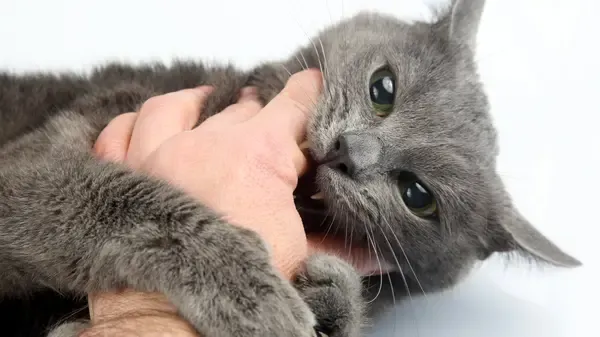
Why does my cat attack me? Decoding behavior and restoring harmony at home
Feline aggression can always be explained. No, your cat isn’t “crazy,” “mean,” or “vicious”…
A cat that attacks rarely does so for no reason. It’s typically a combination of factors: pain, stress, frustration, predatory instinct, lack of physical or mental stimulation, an unsuitable environment, or (quite often) misreading your cat’s signals. Aggression is a reaction, coming from an emotion, not a personality trait set in stone.
Most of the time, attacks happen when a cat feels their physical integrity or personal space threatened, or can no longer express their natural needs. Often, signs of irritation or discomfort go misunderstood or ignored. There’s no “revenge,” just a pure defense mechanism, used as a last resort. Here’s a classic scene: the cat settles on the couch, and their human begins to pet them thinking, “they came over, surely they want cuddles!” Cue the subtle signals: tail starts to swish, ears tilt back, tension in the body, an intent stare… Then boom! The cat bites “for no reason,” and the human for “but they came to me, they must be crazy!”
Let’s dig into the causes
-
Physical pain or illness: A cat in pain may react violently to the slightest touch. Always check with your vet before assuming it’s a behavioral issue.
-
Stress and fear: Environmental changes, new people, loud or unusual sounds… sometimes that’s all it takes for your feline to switch to “angry ninja mode.”
-
Frustration and lack of stimulation: Boredom is the enemy. When the environment is dull, with few games, little exploration, it usually ends with ambushes behind the couch.
-
Predatory behavior: Another often overlooked factor. Your cat is a hunter, and sometimes our movements trigger a predatory sequence… directed at us. And that’s a no-go! That’s why it’s better to offer substitute prey, feather wands, toy mice, balls, rather than your own hand!
-
Human misunderstanding: Insisting on reading your cat’s signals through a “human” lens, demanding cuddles at all costs, or neglecting their non-verbal communication leads to confusion (and, sometimes, a good scratch or bite).
-
Human emotions reflected: Your cat “senses” if you’re nervous, tense, or afraid. For example, if you’ve been bitten before, it’s not surprising that you’re uneasy around your “feline troublemaker.” This climate of uncertainty and discomfort can create or amplify the cat’s own tension, setting off a vicious circle: Cat attacks for reason X or Y, human becomes mistrustful, cat thinks, “I was right to be on guard; something’s dodgy here; my human is acting strange; I feel weird too,” and everyone’s on edge.
-
The payoff behind aggression: Yep, even a negative reaction, being scolded or getting attention (gestures, words, care) after an attack, can reinforce the behavior. A clever cat quickly learns, “every behavior gets a reaction.” The real vicious cycle? Every time your cat attacks, even if you react negatively (shouting, sudden gestures, a simple stare), the cat still gets what they might be after: interaction. For them, sometimes, any reaction is better than being ignored. To break out of this loop, try totally ignoring your cat after aggressive behavior (easier said than done my good woman, right? Yes, I admit it. So come prepared: 3 pairs of pants, mittens, a winter coat, 5 pairs of socks, and resist, quietly walk away or isolate yourself).
-
Ideally, anticipate: read the signals, keep calm, and redirect your cat’s energy to another activity.
Learning to read your cat
“Universal” signals are critical: ears back, dilated pupils, tail swishing, tense body, growling, hissing… Get familiar with common feline communication, but also go further. Learn to interpret the unique ways your companion communicates. You live together: you’re the best detective of their subtle gestures and quirks. Sometimes, your cat invents their own body language just for you…so stay observant, and decode.
Common mistakes to avoid
-
Punishing after the fact: it won’t help… and will even probably make things worse. It may increase tension or stress, making aggression even more likely.
-
Asserting “dominance” or force: Unless you want to test drive that new anti-bite bandage, forget it. Cats don’t operate that way, there’s no hierarchy, no dominance with them, so you’re not speaking the same language with that.
-
Neglecting enrichment: If your cat spends all day bored, it’s time for plan B. Proactively provide alternatives and outlets, before they decide to blow off steam using your limbs. Cat trees, feather toys, hideaways, puzzle games, scratchers, they’re lifesavers!
-
Reading everything through a human lens: Consent applies to whiskered friends, too. A cat is not a plush toy (even if they are so cuuute), respect their physical boundaries.
Taking care of the relationship: concrete steps
-
Enrich their environment (toys, hideaways, climbing circuits, cat trees, rituals).
-
Add regular interactive play with you, at least 10 to 15 minutes, twice a day. Let’s put ourselves in their paws, days can get pretty dull, especially if they live indoors.
-
Respect your cat’s moments of withdrawal or indifference, and notice their specific signals.
-
Reflect on your own emotional state, and how it influences the dynamic with your cat.
A real-life example, straight from a consult: Marion, tired of being scratched by Merlin, transformed her living room into a vertical playground: shelves at different heights, bridges, a lookout in the top of a wardrobe… plus a few extra enrichments. Within a week, far fewer attacks, more stimulation, a peaceful cat… and a human who could finally enjoy her Netflix evenings without risking a toe as a snack.
Every human-cat duo is unique! Solutions must be personalized, and sometimes outside help is needed for complex or emotionally-charged situations. You don’t have to face this alone.
When to consult an animal behaviorist?
When vicious cycles set in or tips above aren’t helping long term, a behavior consult can:
-
Learn to read your cat preemptively, before problems get established
-
Observe the family and cat in context.
-
Analyze relationship dynamics, routines, emotional climate.
-
Offer concrete strategies, all based on respect and consent, for cat and human!
-
Restore trust and calm.
Conclusion: Rebuilding trust, step by step
Aggression in cats isn’t a life sentence, it’s a message. It’s not nastiness or immutable personality. It’s a chance to observe, learn to decode, and rebuild trust. Ask yourself every day: have I understood their signals, respected their boundaries, enriched their world, what do they get from this behavior? With a bit of perspective and a few adjustments, it’s possible to turn a damaged bond into a calm and respectful relationship, for the greater good of both cats and their humans.
Important note
This article presents the most common causes of feline aggression, based on my knowledge, readings, and professional experience. It is by no means an exhaustive list, every cat is unique, and reasons can vary or be complex or multiple. Sometimes a combination of factors is at play, and medical treatment may be needed.
Any behavioral consultation does not replace a veterinary consultation. Always consult your veterinarian first to rule out medical causes.
[Article originally written in French]
Sources
-
Veterinary thesis, “Aggressive Behaviors in Cats”: https://theses.vet-alfort.fr/telecharger.php?id=829
-
CEEPHAO, Cat Aggression: https://ceephao.com/agressivite-chez-le-chat/
-
Felikat, Why Does My Cat Attack Me?: https://www.felikat.org/pourquoi-est-ce-que-mon-chat-mattaque/
-
Styllacare, Why Does My Cat Suddenly Attack Me?: https://styllacare.com/fr/blogs/chat/pourquoi-mon-chat-m-attaque-soudainement
-
Le Point Vétérinaire, Cat Aggressions: https://www.lepointveterinaire.fr/publications/le-point-veterinaire/article/n-424/etape-8-les-agressions-chez-le-chat.html
-
Animalis, Stimulating Your Cat: https://www.animalis.com/conseils/chats/nutrition-chat-chaton/stimuler-votre-chat-le-jeu-comme-cle-de-son-bien-etre/